Two Weeks Later We Spoke Again Quote
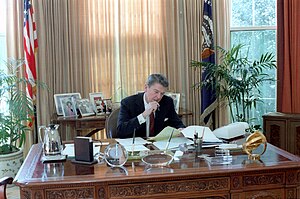
Reagan working on his kickoff State of the Matrimony Address in the Oval Office, 1982
The speeches and debates of Ronald Reagan incorporate the seminal oratory of the 40th President of the United states of america. Reagan began his career in Iowa as a radio broadcaster. In 1937, he moved to Los Angeles where he started acting, first in films and later television. After delivering a stirring speech in support of Barry Goldwater'south presidential candidacy in 1964, he was persuaded to seek the California governorship, winning two years later and again in 1970. In 1980, as the Republican nominee for president of the United States, he defeated incumbent Jimmy Carter. He was reelected in a landslide in 1984, proclaiming that it was "Forenoon in America". Reagan left part in 1989.
Overview [edit]
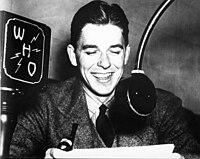
Reagan as a WHO Radio announcer in Des Moines, Iowa, 1934–37
Afterwards graduating from Eureka College in Illinois, Reagan moved first to Iowa to work as a radio broadcaster. And so, in 1937, to Los Angeles where he began a career as an actor, first in films and later television.
In 1964 Reagan endorsed the entrada of bourgeois presidential contender Barry Goldwater. In his speech, "A Time for Choosing", Reagan stressed the need for smaller authorities. The spoken communication raised 1 1000000 dollars for Goldwater [1] and is considered the issue that launched Reagan's political career.[two] It as well marked a shift of the Republican Political party from a moderate to a "Western more politically charged ideology."[iii] California Republicans were impressed with Reagan's political views and charisma subsequently his "Time for Choosing" speech,[iv] and nominated him for Governor of California in 1966. Reagan was elected governor and served two terms.
At the first Bourgeois Political Action Conference (CPAC) in 1974 Reagan addressed the attendees saying "We Volition Be Every bit a Shining City upon a Hill", in reference to John Winthrop's use of the Urban center upon a Hill trope from Matthew five:fourteen; with the improver of "shining" information technology became Reagan's trademark expression.[5]
In 1980 Reagan challenged Jimmy Carter for the presidency of the United States. During their but debate, Reagan used the phrase, "In that location you go over again." The line emerged as a unmarried defining phrase of the 1980 presidential election.[half dozen] The phrase has endured in the political lexicon in news headlines, as a mode to quickly refer to diverse presidential candidates' bringing certain bug upwards repeatedly during debates, or to Reagan himself.[seven] The Associated Press wrote in 2008: "Reagan was a main at capturing a fence moment that everyone volition remember. His 'there y'all go over again' line defused his opponent'southward attack."[8] In the general ballot Reagan won past a landslide.
Reagan was the first American president to address the British Parliament.[9] In a famous address on June eight, 1982, to the British Parliament in the Royal Gallery of the Palace of Westminster, Reagan said, "the frontwards march of freedom and republic will exit Marxism–Leninism on the ash-heap of history."[10] [11]
Reagan ran for reelection in 1984. The Democratic nominee was Walter Mondale. Reagan performed poorly in the first debate, but rebounded in the second debate, and confronted questions well-nigh his historic period, quipping, "I will not brand age an issue of this campaign. I am non going to exploit, for political purposes, my opponent'south youth and inexperience," which generated adulation and laughter, even from Mondale himself.[12] Mondale later recalled that
If Television set can tell the truth, as you say information technology can, y'all'll encounter that I was smiling. Merely I call back if you lot come in close, you'll see some tears coming downwardly considering I knew he had gotten me in that location. That was really the end of my campaign that night, I call back. [I told my wife] the campaign was over, and information technology was.[13]
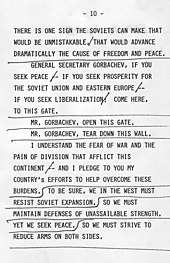
Folio 10 of the "Tear Down this Wall" spoken communication
The disintegration of the Space Shuttle Challenger on January 28, 1986, proved a pivotal moment in Reagan's presidency. All seven astronauts aboard were killed.[fourteen] On the dark of the disaster, Reagan delivered a oral communication, written by Peggy Noonan, in which he said:
The future doesn't vest to the fainthearted; it belongs to the brave... We will never forget them, nor the terminal time we saw them, this morning time, every bit they prepared for their journey and waved goodbye and 'slipped the surly bonds of World' to 'touch the confront of God.'[15]
The speech is ranked as i of the ten best American political speeches of the 20th century.[sixteen]
Reagan believed that Western Democracy offered the all-time hope to open the Berlin Wall.[17] On June 12, 1987, he gave a speech communication at the Wall in which he challenged Soviet leader Mikhail Gorbachev to "Tear down this wall!" Reagan's senior staffers objected to the phrase, simply Reagan overruled them maxim, "I think we'll get out it in."[18] "Tear downwardly this wall!" has been chosen "The four most famous words of Ronald Reagan's Presidency."[19] Although there is some disagreement over how much influence Reagan'south words had on the destruction of the wall, the speech communication is remembered equally an important moment in Cold State of war history and was listed by Time magazine every bit one of the x greatest speeches in history.[18] [xx]
Oratorical style [edit]

Reagan preparing for his farewell address to the nation from the Oval Office, 1989
Reagan's effectiveness equally a public speaker earned him the moniker, "Great Communicator." Former Reagan speechwriter Ken Khachigian wrote, "What made him the Dandy Communicator was Ronald Reagan'south decision and ability to educate his audition, to bring his ideas to life by using illustrations and word pictures to brand his arguments vivid to the listen'southward heart. In short: he was America'southward Instructor."[21]
Franklin D. Roosevelt, from whom Reagan often borrowed, ushered in a new historic period of presidential communication by dissemination his "fireside chats" on the newly invented radio. Reagan, in his time, put his own stamp on presidential communication past harnessing the power of television broadcasting.[22] He used skills adult during his radio, film and telly career, and according to Lou Cannon, Reagan "prepare the standard in using telly to promote his presidency."[22] Khachigian noted 3 qualities that fostered Reagan's success. He described Reagan's voice as "a fine Merlot beingness poured gently into a crystal goblet." Reagan, a trained actor, has excellent "photographic camera presence." Khachigan establish Reagan's ability to create word pictures disquisitional in communicating with his audience.[21]
Reagan said that it was his "empathy" with the American people that made him an effective communicator and leader. Reagan was able to connect to people through storytelling. While this simple course of communicating led detractors such every bit Clark Clifford to label Reagan as "an amiable dunce", Michael K. Deaver likened this dismissive attitude to a "hole-and-corner weapon."[22]
At the end of his political career, Reagan reflected on the moniker "Great Communicator." At his farewell address he said:[22]
I wasn't a not bad communicator, but I communicated nifty things, and they didn't leap full bloom from my brow, they came from the heart of a great nation–from our experience, our wisdom and our conventionalities in the principles that accept guided us for two centuries.
Speeches [edit]
| Governor – first term (1967–1971) |
| Governor – second term (1971–1975) |
| President – commencement term (1981–1985) |
| President – second term (1985–1989) |
| Year | Date | Speech | Location | Media | Text | |
|---|---|---|---|---|---|---|
| 1964 | October 27 | "A Time for Choosing". In this televised speech Reagan stressed his belief in smaller government saying, "The Founding Fathers knew a government can't control the economy without controlling people. And they knew when a government sets out to do that, it must use force and coercion to achieve its purpose. Then we accept come to a time for choosing." The speech launched Reagan's political career. | Los Angeles, CA[23] |  | ||
| 1967 | January 5 | "California and the Problem of Authorities Growth". In his gubernatorial countdown address he outlined his direction for the state saying, "The cost of California'southward authorities is as well loftier. Information technology adversely affects our business organisation climate. Nosotros are going to squeeze and cutting and trim until we reduce the toll of authorities." | Sacramento, CA | | ||
| 1974 | January 25 | "We Will Exist As a Urban center upon a Colina" is a line from a speech Reagan delivered at the start Conservative Political Action Briefing (CPAC) which would become his signature proverb. | Washington, D.C.[24] |  | ||
| 1975 | March one | "Let Them Become Their Way". In the wake of heavy Republican losses in 1974 Reagan resists suggestions to "broaden the base." At the CPAC convention Reagan addressed moderates maxim "let them go their mode."[25] | Washington, D.C.[26] | | ||
| 1976 | March 31 | "To Restore America". In a challenge to President Gerald Ford, Reagan announces his candidacy for the Republican presidential nomination in this televised address. | CA |  | | |
| 1976 | August xix | "A Shining City on a Hill". Reagan'southward impromptu concession speech at the 1976 Republican National Convention has been called a "defining moment of the Reagan Revolution."[27] | Kansas City, MO | |||
| 1977 | February 6 | "The New Republican Political party" was a oral communication delivered at CPAC in which Reagan calls for expanding the Republican Party to African Americans.[28] | Washington, D.C. | | ||
| 1980 | July 17 | "Time to Recapture Our Destiny". Presidential nomination acceptance speech at the 1980 Republican National Convention. Regarding Autonomous opponent Jimmy Carter he said, "A recession is when your neighbour loses his job. A low is when y'all lose yours. And recovery is when Jimmy Carter loses his." | Detroit, MI |  | ||
| 1981 | January 20 | In his kickoff inaugural address, which Reagan himself wrote,[29] he addressed the state'due south economic angst arguing: "In this nowadays crisis, government is not the solution to our problems; government is the problem." Written by Reagan and Ken Khachigian.[thirty] [31] | Washington, D.C. | | ||
| 1981 | April 28 | Accost on the Program for Economical Recovery | Washington, D.C. | | ||
| 1982 | January 26 | First Land of the Union accost. Reagan spoke on economical issues in 1981 in lieu of a Country of the Union address.[ commendation needed ] The spoken communication is known for Reagan'south proposal to increment the power of the states, dubbed "New Federalism" by the media.[32] Reagan recognizes Lenny Skutnik and starts a tradition. (excerpt) | Washington, D.C. | | ||
| 1982 | June 8 | Accost to the British Parliament. Notable for Reagan's use of the expression "ash heap of history" in predicting the fall of the Soviet Union. The phrase was suggested by Tony Dolan[33] | London, UK | |||
| 1982 | June 17 | Reagan'south first address to the United Nations General Assembly was extremely critical of the Soviet Union.[34] He accused the Soviets of "tyranny," "ruthless repression" and "atrocities." He closed by saying, "We must serve mankind through 18-carat disarmament." | New York, NY | | ||
| 1982 | November 22 | "Address to the Nation on Strategic Artillery Reduction and Nuclear Deterrence." Reagan announces the deployment of MX missiles. | Washington, D.C. |  | ||
| 1983 | January 25 | In the 1983 State of the Matrimony Address Reagan stressed that the economy was "on the mend." He warned that deficits were "a articulate and present danger to the basic health of the commonwealth" and recommended a far-ranging freeze on spending.[35] (excerpt) | Washington, D.C. | | ||
| 1983 | March 8 | Speech delivered to the National Clan of Evangelicals. First utilise of the clarification "Evil Empire." The voice communication was written by Tony Dolan.[36] | Orlando, FL |  | | |
| 1983 | March 23 | The Strategic Defence force Initiative is outlined in an address to the nation. | Washington, D.C. | |||
| 1984 | January 25 | 1984 Country of the Union Accost. Reagan report that the economy is in full recovery and calls on Congress to piece of work together to reduce deficits. He announces plans to build a space station maxim, "Nosotros can follow our dreams to afar stars, living and working in space for peaceful economic and scientific gain." (excerpt) | Washington, D.C. | | ||
| 1984 | June half-dozen | The "Boys of Pointe du Hoc" spoken language was delivered on the 40th anniversary of D-24-hour interval. The speech was written by Peggy Noonan.[16] | Normandy |  | | |
| 1985 | January 21 | Second inaugural address to the nation. Considering Jan xx savage on a Sunday, a public celebration was not held but took identify in the Capitol Rotunda the following solar day. January 21 was one of the coldest days on record in Washington, D.C.; due to poor weather, inaugural celebrations were held inside the Capitol.[37] Written past Reagan, Bently Elliott, Noonan and Dolan.[31] | Washington, D.C. | | ||
| 1985 | Feb 6 | 1985 State of the Union Accost. The Reagan Doctrine is introduced. Speech is given on Reagan's 74th birthday. | Washington, D.C. | | ||
| 1986 | January 28 | Address to the nation regarding the Space Shuttle Challenger disaster. The speech is ranked as one of the ten all-time American political speeches of the 20th century[16] | Washington, D.C. | | ||
| 1986 | February 4 | The 1986 State of the Union Address was postponed due to the Infinite Shuttle Challenger disaster. In the speech Reagan calls abortion "a wound in our national conscience" and he reopened the welfare debate saying, "in the welfare culture, the breakdown of the family ... has reached crisis proportions." He explains that the recovery was attributed to "the American people" and their "quiet courage and common sense..." | Washington, D.C. | | ||
| 1987 | January 27 | 1987 State of the Union Address. He said "mistakes were made" in the Iran-Contra affair. | Washington, D.C. | | ||
| 1987 | June 12 | Brandenburg Gate speech communication. Reagan challenges Gorbachev to "Tear down this wall!." The speech made Time magazine'south "Acme 10 Greatest Speeches Listing"[20] and was written by Peter Robinson.[38] | Westward Berlin | | ||
| 1988 | January 25 | 1988 State of the Matrimony Accost. This was Reagan'south last Country of the Wedlock Accost. Not content to rest on his honour, he announced a policy agenda. He famously summarized the effect of regime intervention on the poor proverb: "Some years agone the federal government alleged War on Poverty, and poverty won."[39] (extract) | Washington, D.C. | | ||
| 1989 | Jan 11 | Reagan states in his Farewell Address: "They chosen it the Reagan revolution. Well, I'll accept that, but for me it e'er seemed more like the great rediscovery, a rediscovery of our values and our common sense." The speech was written by Peggy Noonan. | Washington, D.C. | | ||
| 1990 | November nineteen | "The Alliance of Human being". At the dedication of a monument to Winston Churchill, Reagan discusses the autumn of the Berlin Wall the previous year. | Fulton, MO |  | | |
| 1992 | Baronial 17 | "Empire of Ideals" was a speech delivered at the Republican National Convention. Regarding Democratic presidential nominee Bill Clinton Reagan quipped, "I knew Thomas Jefferson. He was a friend of mine. And governor, y'all're no Thomas Jefferson." (excerpt) | Houston, TX | |||
| 1994 | February 3 | Remarks on the occasion of his 83rd altogether | Washington, D.C. | |
Rankings [edit]
In 2009 a list was compiled past professors at the University of Wisconsin–Madison and Texas A&Thousand University and based on the opinions of "137 leading scholars of American public address."[xvi] The speeches past Ronald Reagan which made the list are below:
| #8 | Infinite Shuttle Challenger Disaster Accost |
| #25 | "A Time For Choosing" |
| #29 | "The Evil Empire" |
| #30 | Start Inaugural accost |
| #60 | "Boys of Pointe Du Hoc" |
| #94 | Brandenburg Gate Address |
Fourth dimension mag listed the Brandenburg Gate Address on its list of "Top 10 Greatest Speeches".[20]
Debates [edit]
| Year | Date | Contend | Location | Media | Transcript | |
|---|---|---|---|---|---|---|
| 1980 | February 23 | Debate with former CIA Manager George H. W. Bush for the Republican presidential nomination. When Reagan's microphone is turned off, the sometime governor paraphrases Spencer Tracy and yells, "I paid for this microphone, Mr. Green!" | Nashua, NH |  | ||
| 1980 | October 28 | Presidential debate with President Jimmy Carter. Reagan baits the president by saying, "There you lot go once again," and in closing asks voters: "Are yous improve off than you were iv years ago?" | Cleveland, OH | | ||
| 1984 | October 21 | Second presidential debate with former Vice President Walter Mondale. President Reagan said he wouldn't hold Mondale's "youth and inexperience" against him. | Kansas Urban center, MO | |
Behind the scenes [edit]
-

Reagan at Campsite David working on the 1982 State of the Union
-

Reagan and David Stockman prepare for the presidential debate at Military camp David, October 6, 1984
-

Drafting the second countdown address in the Oval Office study, 1985
-

Writing the 1987 State of the Marriage address in the Residence
-

White House speechwriters meet to develop the Berlin Wall speech, 1987
See too [edit]
- Ronald Reagan Speaks Out Against Socialized Medicine
- State of the Union address
- The states presidential election debates
- Reagan speechwriters
- Tony Blankley
- Aram Bakshian
- Ben T. Elliott
- Jeffrey Hart
- Ken Khachigian
- Peggy Noonan
- Mari Maseng
- John Podhoretz
- Dana Rohrabacher
- David Tell
References [edit]
- ^ Cannon, Lou (June 6, 2004). "Actor, Governor, President, Icon". The Washington Mail service. p. A01. Retrieved Jan 26, 2008.
- ^ Cannon (2001), p. 36.
- ^ Schweizer, Peter; Hall, Wynton C. (October 27, 1964). Landmark Speeches of the American Conservative Movement. ISBN9781585445981 . Retrieved August 9, 2012.
- ^ "The Governors' Gallery – Ronald Reagan". California State Library. Retrieved March 21, 2007.
- ^ Gamble, Richard (May 4, 2009). "How Right Was Reagan?". The American Conservative . Retrieved August ix, 2012.
- ^ "Other stars emerge other than those on the presidential ticket". Gannett News Service. November iv, 2008. Retrieved Nov 5, 2008.
- ^ "At that place You lot Go Again". The Washington Post. January 24, 2008. Retrieved November 5, 2008.
- ^ Bauder, David (October 8, 2008). "So far, debates lack the memorable lines of past". Associated Press. Retrieved November five, 2008.
- ^ Jewell, Elizabeth (2005). U.S. Presidents Factbook – Elizabeth Jewell. ISBN9780375720734 . Retrieved August 9, 2012.
- ^ Robert C. Rowland, and John M. Jones. Reagan at Westminster: Foreshadowing the End of the Cold War (Texas A&M University Press; 2010)
- ^ Speeches to Both Houses, Parliamentary Data List, Standard Note: SN/PC/4092, Last updated: November 27, 2008, Author: Department of Information Services
- ^ "1984 Presidential Debates". CNN. Archived from the original on March 8, 2007. Retrieved May 25, 2007.
- ^ Mondale, Walter. "1984: There You Go Again... Again / Debating Our Destiny Transcript". PBS Newshour (Interview). Interviewed by Lehrer, Jim. Retrieved Feb 29, 2012.
- ^ Berkes, Howard (January 28, 2006). "Challenger: Reporting a Disaster'due south Cold, Hard Facts". NPR. Retrieved April 19, 2008.
- ^ Noonan, Peggy (Jan 28, 1986). "Accost to the Nation on the Explosion of the Space Shuttle Challenger". University of Texas. Retrieved December 27, 2009.
- ^ a b c d Michael Eastward. Eidenmuller (February 13, 2009). "Height 100 Speeches of the 20th Century by Rank". "American Rhetoric. Retrieved September 26, 2011.
- ^ Boyd, Gerald M (June thirteen, 1987). "Raze Berlin Wall, Reagan Urges Soviet". The New York Times . Retrieved February 9, 2008.
- ^ a b Walsh, Kenneth T (June 2007). "Seizing the Moment". U.S. News & World Report. pp. 39–41. Archived from the original on June 14, 2007. Retrieved June 27, 2007.
- ^ Ratnesar, Romesh (June 11, 2007). "xx Years After "Tear Downward This Wall" – TIME". Time. Archived from the original on June 12, 2007. Retrieved February 19, 2008.
- ^ a b c "Ronald Reagan – Acme 10 Greatest Speeches". Time. September 17, 2008. Archived from the original on September 19, 2008. Retrieved August nine, 2012.
- ^ a b "Ken Khachigian: What fabricated Reagan the Great Communicator". Orange Canton Register. Feb five, 2011. Retrieved Dec 30, 2021.
{{cite web}}: CS1 maint: url-condition (link) - ^ a b c d "Actor, Governor, President, Icon". washingtonpost.com. June half-dozen, 2004. Retrieved August 9, 2012.
- ^ Michael E. Eidenmuller (October 27, 1964). "Ronald Reagan – A Time for Choosing". American Rhetoric. Retrieved August 9, 2012.
- ^ "CPAC 1974 :: Ronald Reagan | The American Bourgeois Union". Conservative.org. January 25, 1974. Retrieved Baronial ix, 2012.
- ^ "The Soul of the Republican Party | Bourgeois News, Views & Books". Humanevents.com. Retrieved August 9, 2012.
- ^ "CPAC 1975 :: Ronald Reagan | The American Bourgeois Union". Conservative.org. March 1, 1975. Retrieved Baronial 9, 2012.
- ^ Reagan, Michael; Denney, Jim (January 18, 2011). The New Reagan Revolution: How Ronald Reagan's Principles Tin can Restore ... – Michael Reagan, Jim Denney. ISBN9781429989961 . Retrieved Baronial 9, 2012.
- ^ "Ronald Reagan and the African American – Kiron Thou. Skinner". Nationalreview.com. Retrieved August ix, 2012.
- ^ Murray, Robert K.; Tim H. Approving (1993). Greatness in the White Firm. Penn State Press. p. fourscore. ISBN0-271-02486-0.
- ^ Curtis, Diane (May 9, 1981) "An Ex-White House Speechwriter Compares the Styles of Reagan and Nixon". United Press International.
- ^ a b Ryan, Halford Ross (January 21, 1985). The Inaugural Addresses of Twentieth-Century American Presidents – Halford Ross Ryan. ISBN9780275940393 . Retrieved August 9, 2012.
- ^ Busch, Andrew (November 13, 1979). Ronald Reagan and the Politics of Freedom – Andrew Busch. ISBN9780742520530 . Retrieved August 9, 2012.
- ^ "Ash Heap of History: President Reagan'south Westminster Address 20 Years Later". Reagansheritage.org. June 3, 2002. Retrieved August 9, 2012.
- ^ HighBeam
- ^ "Logansport Pharos Tribune, Jan 26, 1983 : Forepart Page". NewspaperARCHIVE.com. Retrieved August 9, 2012.
- ^ "RELEASE: 'I Accept a Dream' leads top 100 speeches of the century". News.wisc.edu. Retrieved Baronial ix, 2012.
- ^ "Phil Gailey and Warren Weaver, Jr., "Conference"". The New York Times, June five, 1982. June v, 1982. Retrieved January 27, 2011.
- ^ "xx Years After "Tear Downwards This Wall"". Fourth dimension. June 11, 2007. Retrieved Dec 28, 2013.
- ^ Researcher, Cq (August 18, 2009). Issues for Debate in Social Policy: Selections From CQ Researcher. ISBN9781412979412 . Retrieved August nine, 2012.
External links [edit]
- Presidential Speech Archive – Ronald Reagan, Miller Center, sound and video files
- The Great Communicator, spoken language archive at the Ronald Reagan Presidential Foundation & Library
- Ronald Reagan's Major Speeches, spoken communication and debate transcripts at the archive of the Ronald Reagan Presidential Library
- Speeches, images of major speeches at the Ronald Reagan Presidential Library
- Ronald Reagan, In His Ain Words, National Public Radio
- Campaigns and Elections, content and videos of debates at the Miller Heart
- The Reagan Foundation, official YouTube channel
- Reagan Speech communication Annal, CNN
- Speeches and other Media Uses by Ronald Reagan, by Russell D. Renka
- President Reagan's 83rd Birthday Commemoration, C-SPAN video, February 3, 1994
Source: https://en.wikipedia.org/wiki/Speeches_and_debates_of_Ronald_Reagan
0 Response to "Two Weeks Later We Spoke Again Quote"
Post a Comment